

Issue #5
Your Documentation Debt Is Due – And The Interest Rate Is Killer 💸
Let's talk about the elephant in the room: documentation. You know, that thing everyone agrees is important but somehow never makes it to the top of the priority list.
Hey developrrrs! 👋 Hope you’re surviving your backlog of tickets and endless stream of Slack notifications. Remember last week when I promised to spill the tea about why your team keeps pushing docs to the mythical “later”? Well, grab your coffee (or your fourth energy drink of the day – no judgment here) and your favorite excuse for not documenting – we’re about to get uncomfortably real.
🤿 Deep Dive
Let’s talk about the elephant in the room: documentation. You know, that thing everyone agrees is important but somehow never makes it to the top of the priority list. Like those New Year’s resolutions we all make, documentation is something we all swear we’ll get better at… eventually. Well, today we’re diving into why “eventually” is costing your team more than you think.
🦥 The “We’ll Document It Later” Syndrome
Fun fact: If putting off documentation was an Olympic sport, most dev teams would be gold medalists. We’ve all been there – confidently typing “TODO: add docs” in our PRs, fully knowing that “later” is right up there with “the check is in the mail” and “one more episode before bed” in the hall of fame of lies we tell ourselves.
“We don’t have time for documentation. We need to deliver,” they say. I hear this one a lot, especially from teams under pressure to ship features fast. But here’s the thing: this short-term thinking is like taking out a high-interest technical debt loan. Sure, you might ship that feature a day earlier, but you’re setting yourself up for weeks of slower development down the line.
The real culprit? It often comes down to leadership priorities. When the pressure to deliver features intensifies, documentation becomes the first corner we cut. According to the DORA State of DevOps Report 2022, organizations that balance speed and stability effectively are more likely to minimize technical debt. Teams need engineering managers who understand that documentation isn’t just busywork – it’s a critical investment in the team’s long-term velocity. More importantly, they need managers who will champion this message to leadership and fight for the time needed to maintain proper documentation.
A while back, our tech lead left for a new opportunity, and suddenly our ‘move fast’ strategy didn’t seem so smart. Critical deployment processes, architecture decisions, and system dependencies were all locked in his head. The two-week knowledge transfer we planned turned into two months of reverse engineering our own systems.
🦖 When Docs Turn Into Digital Fossils
Here’s a horror story: I once worked on a project that required integrating APIs from two different teams. Following their documentation to the letter (like any sensible developer would), I ended up with a completely non-functional app. Turns out, both sets of docs were outdated. The real kicker? The only way to get current information was by playing a game of Slack tag - reaching out to the teams, getting bounced around different channels and threads, and eventually landing on the one person who actually knew how things worked. A task that should have taken a few days turned into a couple of weeks of detective work.
A McKinsey study found that employees spend 1.8 hours per day searching for information, totaling nearly 12 weeks per year! Stale documentation isn’t just annoying – it’s literally eating your productivity alive.
🏰 Breaking the Knowledge Silos (Because “Ask Jason” Isn’t a Documentation Strategy)
Remember Jason from last week? You know, the one whose name shows up in every other comment as the go-to person for answers? (For those just joining us, Jason is that developer who somehow knows everything about your systems but hasn’t documented any of it). Well, every team has a Jason. According to Panopto’s Workplace Knowledge and Productivity Report, employees spend an average of 5.3 hours every week waiting for information from their colleagues or recreating existing institutional knowledge. Let that sink in – that’s nearly three days every month spent playing detective in your own codebase or waiting for someone to respond to your “quick question” in Slack. Not exactly the kind of workplace innovation we’re aiming for.
I once spent hours figuring out how to create and deploy an artifact because the process wasn’t documented. What should have been a 15-minute task turned into a half-day adventure. And guess what? The only person who knew the process was on vacation, sipping margaritas on a beach somewhere (good for them, bad for us).
These knowledge silos aren’t just frustrating – they’re bottlenecks waiting to happen. When only one or two people can perform critical tasks, your delivery pipeline becomes as fragile as a house of cards in a wind tunnel. One vacation request, and suddenly your deployment schedule looks like a game of Jenga gone wrong.
Pro tip: If your team’s vacation requests cause more panic than a production outage, you might have a knowledge silo problem. 🚨
📚 Making Documentation Part of Your Pipeline (Without Writing War and Peace)
Here’s how we turned documentation from everyone’s least favorite chore into something that actually happens:
🤖 Automate What You Can
-
Use documentation generation tools that pull from your code comments
-
Set up automated checks for documentation coverage
-
Implement documentation testing (yes, it’s a thing!) to catch broken links and outdated references
-
Create templates that auto-populate with project metadata
✅ Make It Part of the Definition of Done
-
No ticket moves to “Done” without updated docs
-
Include documentation tasks in sprint planning
-
Add documentation review to your PR checklist
-
Track documentation debt just like technical debt
🛠️ Build It Into Your Tools
-
Integrate documentation platforms with your development environment
-
Set up automated notifications for outdated docs
-
Use collaborative documentation tools that make updates easy
-
Implement version control for your documentation
📋 Create Clear Standards
-
Establish documentation templates for different types of content
-
Define what needs documentation (and what doesn’t)
-
Set up style guides to maintain consistency
-
Create checklists for different documentation types
Remember: Documentation is like deodorant – you might not enjoy applying it, but everyone around you appreciates that you did.
Stay documented, my friends! ✌️
Powered by caffeine ☕ and the collective sighs of developers reading outdated wikis
📊 Stat
Teams with quality documentation are 2.4x more likely to meet or exceed their reliability targets
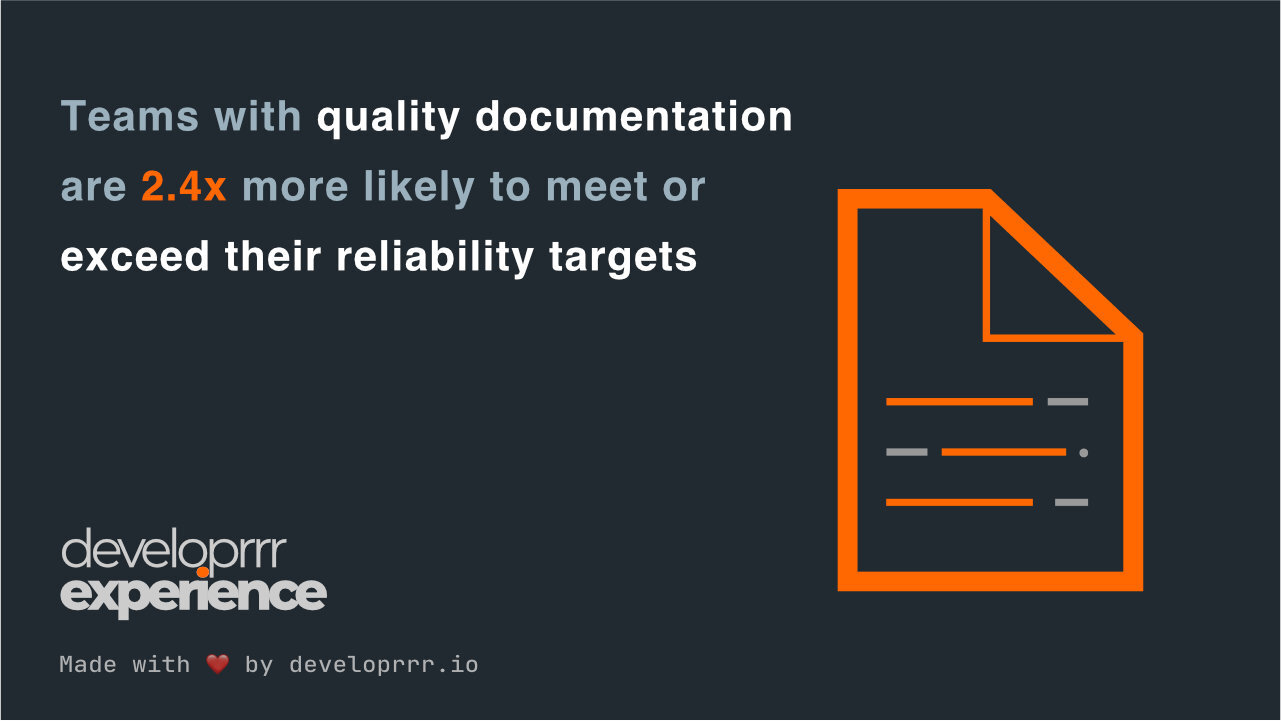
Teams with high-quality internal documentation are 2.4 times more likely to meet or exceed their reliability targets, according to the Accelerate State of DevOps 2021 report. Quality documentation—accurate, clear, and goal-oriented—supports faster and more reliable software delivery while fostering better operational performance.
Only about 25% of teams report having good documentation, yet even small improvements can significantly enhance outcomes. In today’s complex tech environments, where specialized roles and intricate systems abound, documentation bridges knowledge gaps, enabling teams to implement technical practices like observability and automation effectively.
📌 Essential Reads
🤖 GitHub’s Survey Highlights AI’s Role in Enhancing Developer Experience. A GitHub survey reveals that 92% of U.S.-based developers are already utilizing AI coding tools both professionally and personally. Despite advancements in DevOps, developers still find waiting on builds and tests to be time-consuming. The survey also indicates a strong desire among developers for increased collaboration and suggests that AI could play a pivotal role in facilitating this.
🧑💻 TechCrunch Discusses the Growing Focus on Developer Experience Over Productivity. An article from TechCrunch argues that enhancing developer experience is becoming more crucial than merely boosting productivity. It suggests that a positive DevEx can prevent burnout and lead to better products. The piece also explores the role of platform teams in providing a great developer experience.
🕰️ Developer Experience: Past, Present & Future. This blog post explores the evolution of developer experience, tracing its conceptual origins and discussing its current significance in the software industry. It provides a historical perspective and insights into future trends, highlighting the importance of DevEx in modern software development.
🛠️ Tools
-
turborepo is a high-performance build system for JavaScript and TypeScript monorepos, focusing on caching and parallelism.
-
Driftctl is a drift detection tool for infrastructure-as-code, enabling teams to identify and manage unmanaged changes.
-
Earthly is a build automation tool that supports reproducible builds using a container-based, Dockerfile-like syntax.
Get the next issue on Thursday
5-minute weekly reads showing how top engineering teams solve their biggest DevEx challenges and reduce burnout.
Subscribe for freeDelivered every Thursday. Trusted by 3,000+ engineers at companies like Stripe, Google, and Netflix.